21 May 2009, by Eric
I’m not usually one for ripping on people. When I was about twelve, I had a year-long sports radio phase, in which I listened to all sorts of clowns and callers berate athletes. Sports radio gave way to sports reading – ESPN the Mag and Sports Illustrated became my beacons for sports knowledge and the source of my opinions. Of all the guys in those magazines, Rick Reilly daunted my young mind the most. His stories were sometimes grouchy and sometimes moving and sometimes cerebral. Probably for no other reason than their location on the back page, Reilly’s columns seemed an elevated form of sports writing.
Obviously that was foolhardy and naïve. Much the same way I learned that most of the guys with names like Vic “The Brick” Jacobs were worthless blowhards, I learned that placement on the vaunted back page of SI does not a good column make. Rick Reilly is an imperfect columnist at best. He can be sappy and clichéd and repetitive and over-reliant on dental metaphors. But overall I find him a compelling stylist, with a great sense of empathy and although we often disagree, a tendency to provoke worthwhile lines of thought.
But his latest piece is so bad I want to cry. I want to sit in the dark on the floor in my room and weep for the people who have been subjected to these words, for the spineless editor who allowed them to reach those masses, and for the writer himself who is surely incapable of staring proudly at his reflection in any mirror. The concept is hackneyed. The jokes are flat. The content itself, well, there were more good ideas in the House Republicans’ 18-Page 2009 Alternate Budget.
I won’t go full Fire Joe Morgan on it, but here are some highlights:
The title:
Here’s My Solution For Fixing Baseball: Put Me In Charge.
First problem is the assumption that baseball is broken. Second problem is that, in the first sentence of the article, Rick says he hates baseball:
I personally find baseball so crushingly boring I would happily plunge knitting needles into my eyes to avoid another snap zoom of Joe Torre's nostril hairs.
Clearly, he’s now set himself up as a credible and very funny potential commissioner. I bet he has some great, original ideas. I’ve taken the liberty of listing them here in order to save you from his commentary.
1. A pitch clock.
2. Mandatory autographs.
3. Olympic style steroid testing.
4. Bad at-bat music joke.
5. DH in the NL
6. More fines. Just because. (Joke).
7. Umpires determine when a game is rained out.
8. Balls that hit foul pole are foul. (Joke, I think?)
9. Age Minimum for draft. No mention of international players.
10. Joke not worth repeating.
Anyway, there’s nothing new here. There isn’t even anything old said in a new way. It’s just lazy, boring, and complacent. It’s the kind of column that makes me wonder why, when so many people are writing about sports with so much energy and curiosity, I would ever bother with Rick Reilly again. It’s the kind of column that makes “mainstream journalism” for all of its resources, look hopelessly stale and out of touch.
Have you guys had already given up on Reilly, given up on all the Paiges and Plaschkes of the world? Maybe that comfy perch at the top of an institution – even a crumbling one – can destroy a writer. It isn’t news that there’s better, hungrier stuff on the blogs. But man, I'd like to see the old guard put up a fight.
19 May 2009, by Eric
This semi-divine poem by Gail Mazure celebrates the Red Sox and hope and honors fellow poet James Tate. It encapsulates the fallibility of baseball and the futility of a fan watching or listening but not playing. When you're done, check out Mazure, who's written more than one great baseball poem in her day...
This morning I argued with a friend
about angels. I didn't believe
in his belief in them-- I cannot
believe they're not a metaphor.
Our argument, affectionate,
lacking an animus, went nowhere.
We promised to talk again soon.
Now, when I'm driving away
from Boston and the Red Sox
are losing, I hear the announcer
say, 'No angels in the sky today' -
baseball-ese for a cloudless afternoon,
no shadows to help a man
who waits in the outfield
staring into the August sun.
Although I know the announcer's
not a rabbi or a sage (no,
he's a sort of sage, disconsolate
philosopher of batting slumps
and injuries), still, I scan
the pale blue sky through my
polarized windshield, fervently
hopeful for my fading team
and I feel something a little
foolish, a prayerful throbbing
in my throat, and remember
being told years ago that men
are only little lower
than the angels. Floating ahead of me
at the Vermont border, I see
a few wispy, horse mane clouds
which I quietly pray will drift
down to Fenway Park, where
a demonic opponent has just
slammed another Red Sox pitch,
and the centerfielder - call him 'Jim' -
runs back, back, back,
looking heavenward,
and is shielded and doesn't lose
the white ball in the glare.
14 May 2009, by Eric
Baseball is a self-dichotomizing sport. Rivalries like Red Sox and Yankees, Giants and Dodgers, Cardinals and Cubs are organic and intuitive. The first place team and the last place team seem generations apart. The American League and National League coexist in a state of symbiotic tension. There’s strain between the players and the press, the ownership and the fans, the fans and the fans, the players and the players, the owners and the owners.
This tendency, I think, can be dangerous. Baseball is also a self-regulating sport. Commissioners can literally remove players from the game with the flash of a pen. In an official sense, Shoeless Joe and Pete Rose were flat-out disappeared. The Hall of Fame decides, with vicious and often unjust finality, what player is immortal and what player is merely good. The whole thing, including the old guard media, is very insulated. Hence the struggles for racial integration.
But stark differences and harsh decisions are the manner of baseball; safe or out, honest or dishonest, Maddux or Clemens. Slowness to change is part of it too. Before steroids, that paradigm seemed passable enough. The game worked things out: some guys were piled upon with praise, others simply spat upon, others still faded to oblivion. And baseball slogged through it, draconian and direct as ever, nuance be damned. But all of a sudden steroids are changing the game faster than it can react, and we no longer know enough to be draconian. Nuance is quickly becoming our only option.
Simply put, if baseball doesn’t put on its perspective goggles – and I include the fans and the media and you and me in that definition of baseball – this steroid thing will spiral out of control. It’s bad enough now, with columnists calling for stoning and banishment and chopped off hands and everything. The quickness to react, especially in anger, is an extension of the good guy/bad guy worldview. Life is complicated. We screw up. So let’s step back, reconsider, and not get all huffed up over a problem we don’t quite understand yet. Let’s continue to deal with cases justly as they come up, but trade the histrionics for a sense of history.
Sure, there are winners and losers in sports and good guys and bad guys on television. But things aren’t quite so simple in real life.
12 May 2009, by Eric
This is perhaps the second most famous baseball poem of all time. If not, it contains one of the most famous lines: Tinker to Evers to Chance. Enjoy Franklin Pierce Adams' work here, and try to remember that there was a time when the words Chicago and Cubs did not add up to inevitable failure
- These are the saddest of possible words:
- "Tinker to Evers to Chance."
- Trio of bear cubs, and fleeter than birds,
- Tinker and Evers and Chance.
- Ruthlessly pricking our gonfalon bubble,
- Making a Giant hit into a double --
- Words that are heavy with nothing but trouble:
- "Tinker to Evers to Chance."
*Gonfalon, wikipedia points out, means pennant.
11 May 2009, by Eric
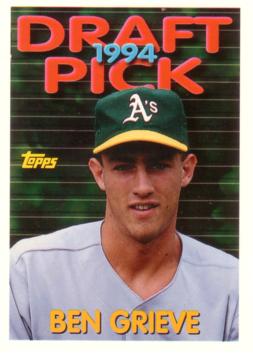 Say yes to outfielder Ben Grieve and you can transform his legacy.
Ben Grieve, of the A's and Rays, is one of thousands of ex-big leaguers waiting for a sponsor. His page is wide open and for $10 – that’s 7 cents a day for a year or 21 cents for each of his 118 career homeruns -- you can give Ben a chance to escape Baseball-Reference (and sadly, real life) anonymity by garnishing his page with a clever anecdote, fond memory, or completely unrelated advertisement.
Player Report:
Ben Grieve burst forth like a tidal wave from Oakland’s East Bay, soaking the American League in the spray of his loping strikeouts and late-inning runs batted in. He was as consistent as the Pacific tide those three glorious seasons in the AL West, putting up an OPS of.844, .840 and .845 in 1998, 1999, and 2000. Then, in the first days of the new millennium, Ben Grieve experienced his own personal Y2K disaster. He was dealt to Tampa in a small-market ménage trios that saw Johnny Damon, Mark Ellis, Cory Lidle (RIP), AJ Hinch (mazel tov), Angel Berroa, and the legendary Roberto Hernandez pack up and move. Old Ben never hit above .264 again. The pop was gone, bogged down in the pulpy Tropicana Field air. Long story short, he played poorly for three seasons in Tampa then drifted around the NL Central for a couple seasons before disappearing from the Major Leagues for good. These days Grieve is a stay at home dad in Arlington, Texas: "The best way to describe my life would be the life of a nanny,” he said. Well nannies need taking care of too. You can help.
Some fun facts about Ben:
-In 1998, Ben was named an All Star and Rookie of the Year. He never won another award in baseball (besides most double plays grounded into in 2000).
-His father Tom (ex-Ranger GM and current broadcaster) blamed Ben’s Tampa Bay failings on excessive pressure from the organization’s management!
-Lots of girls and boys in the 90s loved making internet fan pages for Ben! Like Jen! Andrea! And Darron! I wonder where those three are now that Ben really needs them.
-WNBA Star (there really is such a thing) Lindsay Whalen is married to a Ben Grieve. But not the same Ben Grieve. This Ben Grieve's wife is even more anonymous than he is.
Click Here To Sponsor Ben Grieve!
[Have a player you'd like to see featured here? Does your childhood hero need a home? Feel free to send your suggestions to tips (at) pitchersandpoets (dot) com]